
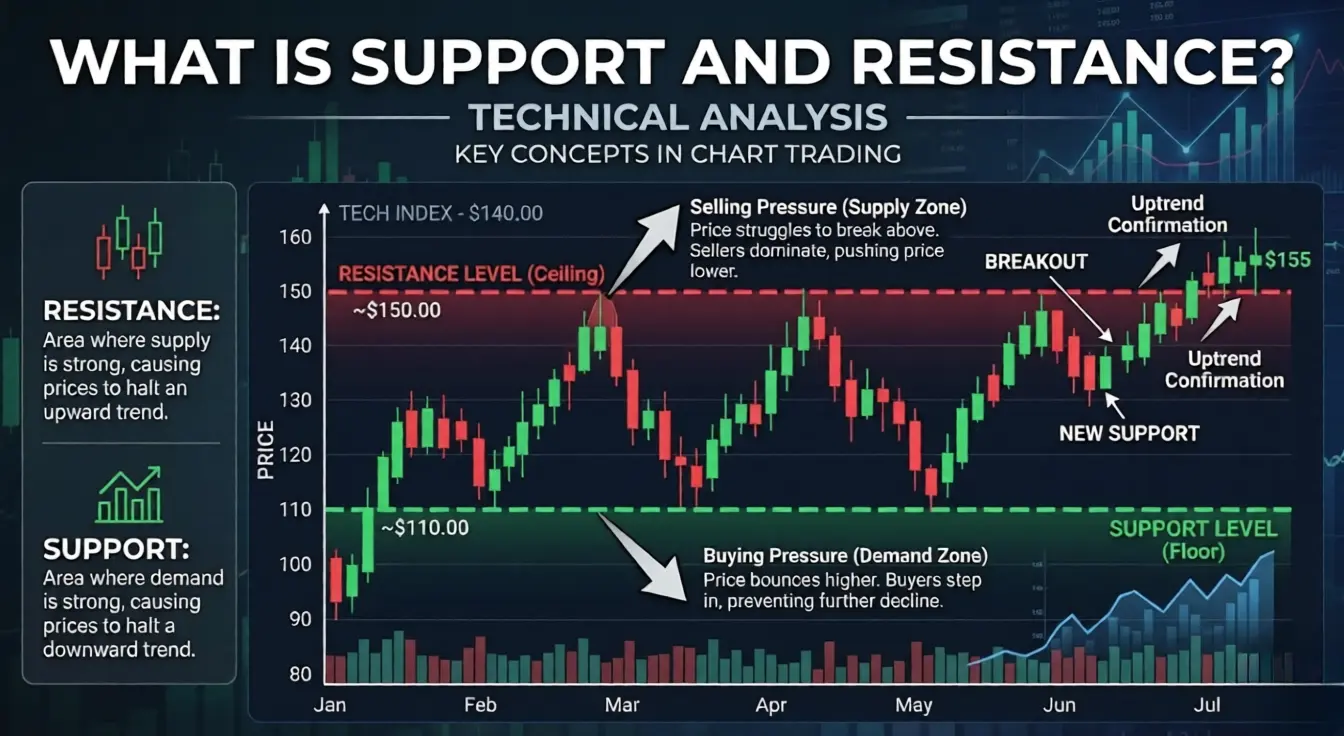
What is Support and Resistance in Trading? Explained for Beginners

Support and resistance is one of the most important concepts in technical analysis. If you understand support and resistance correctly, you can understand market psychology, find better entry and exit points, and improve your trading strategy.
In simple terms, support and resistance are price levels where the market tends to stop, reverse, or slow down.
This guide is written for beginners, so we will explain everything in a simple and clear way.
What is Support in Trading?
Support is a price level where a downtrend tends to pause due to increased buying interest. When the price falls to the support level, buyers enter the market and push the price back up.
Think of support as a floor that prevents price from falling further.
Key Characteristics of Support:
- Located below the current price
- Buyers are stronger than sellers
- Price often bounces upward from this level
- The more times price touches support, the stronger it becomes
Example:
If a stock falls to $100 multiple times and then goes back up, the $100 level becomes a support level.
What is Resistance in Trading?
Resistance is a price level where an uptrend tends to pause due to increased selling pressure. When the price rises to the resistance level, sellers enter the market and push the price back down.
Think of resistance as a ceiling that prevents price from rising further.
Key Characteristics of Resistance:
- Located above the current price
- Sellers are stronger than buyers
- Price often reverses downward from this level
- The more times price touches resistance, the stronger it becomes
Example:
If a stock rises to $150 multiple times and then falls, the $150 level becomes a resistance level.
Why Support and Resistance Work
Support and resistance levels work because of market psychology and supply and demand.
These levels represent areas where:
- Traders previously bought or sold
- Large institutions entered trades
- Many stop-loss and take-profit orders are placed
- Traders remember these price levels.
This creates strong reaction zones in the market.
Main reasons why these levels work:
- Supply and demand
- Institutional trading
- Stop-loss clusters
- Market psychology
- Previous price history
Types of Support and Resistance
There are several types of support and resistance in trading:
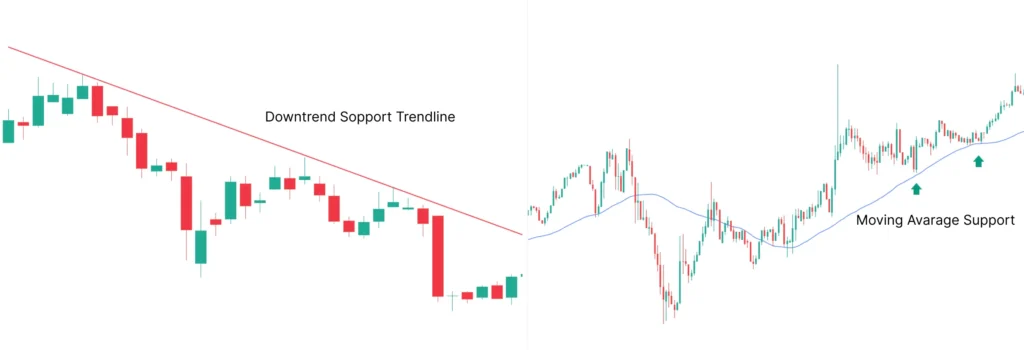
1. Horizontal Support and Resistance
This is the most common type. Price repeatedly bounces from the same horizontal price level.
2. Trendline Support and Resistance
Support or resistance that forms along a trend line. In an uptrend, the trendline acts as support. In a downtrend, the trendline acts as resistance.
3. Moving Average Support and Resistance
Moving averages like the 50 MA and 200 MA often act as dynamic support and resistance levels.
4. Dynamic Support and Resistance
These are levels that change over time, such as:
-
- Moving averages
- Trendlines
- Channels
- VWAP
Support Becomes Resistance
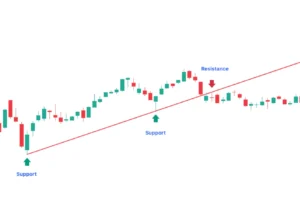
One of the most important concepts in trading is role reversal.
- When support breaks, it often becomes resistance.
- When resistance breaks, it often becomes support.
This is called support and resistance flip or role reversal.
This happens because traders who missed the breakout wait for price to come back to the level.
How to Draw Support and Resistance
Follow these steps:
- Open a chart (TradingView, MetaTrader, etc.)
- Use the horizontal line tool
- Mark levels where price reversed multiple times
- Focus on zones, not exact lines
- Look at higher time frames first (4H, Daily)
- Adjust levels to touch multiple wicks or bodies
- Do not draw too many lines
Important Tip: Support and resistance are zones, not exact lines.
Common Mistakes Beginners Make
- Beginner traders often make these mistakes:
- Drawing too many support and resistance lines
- Treating levels as exact prices
- Ignoring higher time frames
- Not waiting for confirmation
- Trading every touch of support/resistance
- Ignoring trend direction
Simple Support and Resistance Trading Strategy
Here is a basic beginner strategy:
Support Trade:
- Price comes to support
- Wait for bullish candle confirmation
- Enter buy
- Stop loss below support
- Take profit near resistance
Resistance Trade:
- Price comes to resistance
- Wait for bearish candle confirmation
- Enter sell
- Stop loss above resistance
- Take profit near support
