
The Stochastic RSI combines the strengths of the Relative Strength Index and the Stochastic Oscillator into a more sensitive momentum tool. Traders use it to detect overbought and oversold conditions with greater precision, especially when traditional RSI moves too slowly. This indicator helps identify momentum shifts earlier, giving market participants an edge in timing entries and exits.
What Is Stochastic RSI?
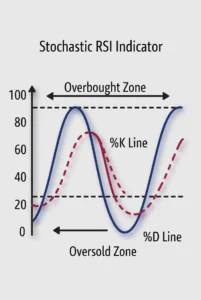
Stochastic RSI, often called StochRSI, applies the Stochastic formula directly to RSI values rather than raw price data. It measures where the current RSI stands within its recent high-low range over a chosen lookback period, typically 14. The result oscillates between 0 and 100, making extreme levels easier to spot.
By normalizing RSI this way, StochRSI becomes more responsive to short-term momentum changes. It excels in ranging markets and during the early stages of trend reversals, where classic indicators might lag.
Key Differences Between Stochastic RSI and Traditional RSI
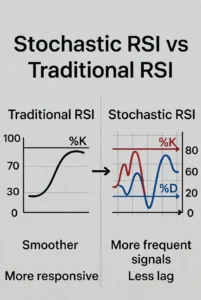
Traditional RSI calculates the speed and change of price movements over a set period and identifies overbought conditions above 70 and oversold below 30. In contrast, Stochastic RSI takes those RSI readings and treats them as the input for a Stochastic calculation, producing faster signals through %K and %D lines.
While RSI tends to stay smoother and produces fewer false signals, Stochastic RSI reacts more quickly but can generate whipsaws in strong trends. The added sensitivity makes StochRSI particularly useful for active traders seeking timely opportunities.
How Stochastic RSI Is Calculated
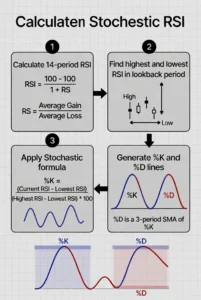
The calculation starts with the standard 14-period RSI. Next, the highest and lowest RSI values over the chosen StochRSI period (commonly 14) are identified. The current RSI is then scaled into a 0-100 range using the Stochastic formula.
The fast %K line usually uses a 3-period smoothing, while the %D line represents a 3-period simple moving average of %K. These settings can be adjusted based on the asset’s volatility and the trader’s timeframe.
Overbought and Oversold Levels in Stochastic RSI
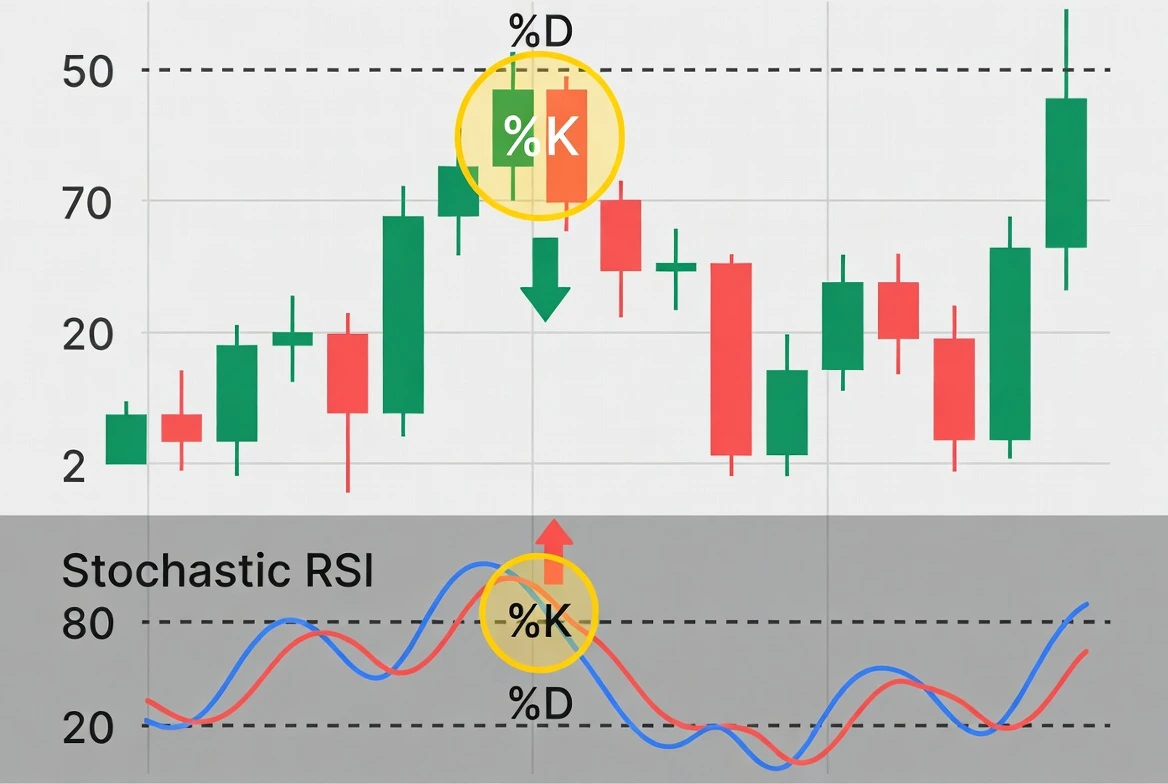
Common threshold levels for Stochastic RSI are 80 for overbought and 20 for oversold. When the indicator rises above 80, it suggests potential exhaustion in upward momentum. A drop below 20 indicates possible oversold conditions ripe for a bounce.
Stronger signals often appear when the %K line crosses the %D line while exiting these extreme zones. In highly volatile markets, some traders prefer custom levels such as 85/15 or 75/25 to reduce noise.
Practical Trading Strategies with Stochastic RSI
Traders frequently combine Stochastic RSI with price action for confirmation. In an uptrend, a move above 20 after oversold conditions can signal a long entry. In a downtrend, a cross below 80 from overbought territory may justify short positions.
Divergence provides another powerful setup. When price makes a new high but Stochastic RSI fails to confirm it, bearish divergence warns of weakening momentum. Bullish divergence occurs in the opposite scenario and often precedes upward reversals.
The 50 level also serves as a trend filter. Readings consistently above 50 support bullish bias, while values below 50 favor bearish conditions.
Important Considerations When Using Stochastic RSI
Despite its advantages, Stochastic RSI can produce frequent false signals, especially in strong trending markets where it remains overbought or oversold for extended periods. Always pair it with other tools such as support and resistance levels, moving averages, or volume analysis.
Timeframe selection matters greatly. Shorter intervals like 5-minute or 15-minute charts suit day traders, while daily or weekly charts work better for swing traders seeking cleaner signals.
Risk management remains essential. Place stop-loss orders beyond recent swing highs or lows and avoid relying solely on any single indicator.
The Stochastic RSI serves as a valuable addition to any technical toolbox. Its heightened sensitivity helps traders catch momentum turns ahead of the crowd, provided it is used with discipline and proper context.