

Introduction to Dow Theory
The Dow Theory is one of the oldest and most important principles in technical analysis. Developed from the work of Charles Dow, the founder of The Wall Street Journal and co-founder of Dow Jones & Company, Dow Theory helps traders understand market trends and overall market direction.
The Dow Theory is based on the idea that the stock market moves in trends and that these trends reflect all available information. Even though the theory was developed in the late 19th century, it is still widely used today by traders and investors to analyze financial markets.
In this guide, you will learn what the Dow Theory is, how it works, its main principles, and how traders use it in technical analysis.
The History of Dow Theory
Charles Dow first introduced the basic ideas of Dow Theory through a series of editorials published in The Wall Street Journal between 1899 and 1902. After his death, other analysts like William Hamilton and Robert Rhea expanded and organized his ideas into what we now call Dow Theory.
Dow never wrote a formal book about the theory. Instead, his ideas were compiled and structured later, but they became the foundation of modern technical analysis.
The Six Principles of Dow Theory
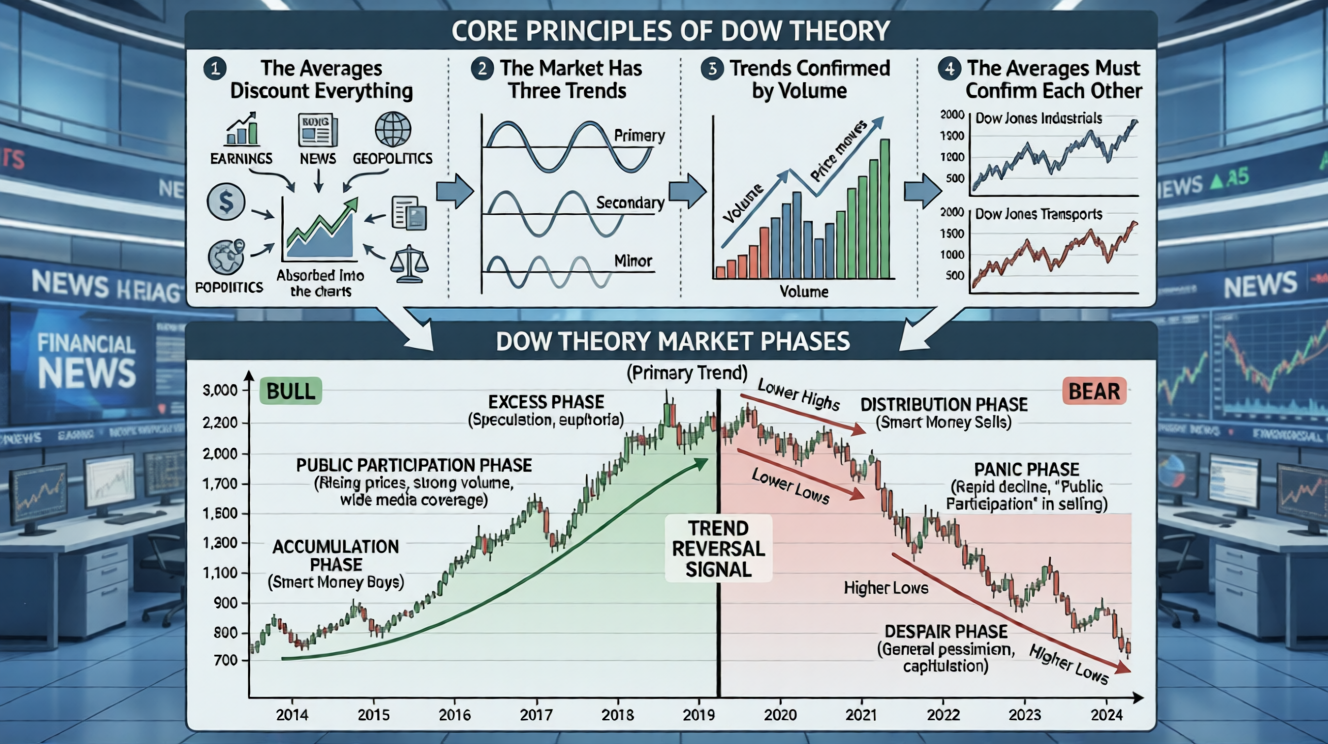
Dow Theory is based on six main principles. Understanding these principles is essential for understanding how market trends work.
1. The Market Discounts Everything
This principle states that all available information — economic data, political events, interest rates, company earnings, and investor expectations — is already reflected in the market price.
In other words, traders do not need to analyze every news event because the market price already includes all known information.
2. The Market Has Three Types of Trends
According to Dow Theory, the market moves in three types of trends:
Primary Trend – Long-term trend (months to years)
Secondary Trend – Medium-term trend (weeks to months)
Minor Trend – Short-term trend (days to weeks)
Primary trends are the most important because they represent the main direction of the market.
Primary trends can be:
Bull Market (uptrend)
Bear Market (downtrend)
3. Primary Trends Have Three Phases
Dow Theory states that primary trends develop in three phases:
Accumulation Phase
This phase occurs when informed investors start buying or selling before the general public realizes the trend.
Public Participation Phase
This is when the majority of traders recognize the trend and start following it. This phase usually has the strongest price movement.
Distribution Phase
This phase occurs when informed investors start closing their positions and the trend begins to weaken.
4. The Averages Must Confirm Each Other
Dow Theory originally used two indices:
The Dow Jones Industrial Average
The Dow Jones Transportation Average
According to Dow Theory, a trend is confirmed only when both averages move in the same direction. If one index goes up and the other does not, the trend is considered weak or unconfirmed.
5. Volume Must Confirm the Trend
Volume should increase in the direction of the main trend:
- In an uptrend, volume should increase when price rises.
- In a downtrend, volume should increase when price falls.
If volume does not confirm the trend, the trend may be weak.
6. A Trend Remains in Effect Until a Clear Reversal Occurs
This principle states that a trend continues until there is a clear signal that it has reversed. Traders should assume that the trend is still active until strong evidence shows that the trend has changed.
This idea is the foundation of the famous trading phrase:
“The trend is your friend.”
Why Dow Theory Is Important in Technical Analysis
Dow Theory is important because it forms the foundation of modern technical analysis. Many popular concepts come from Dow Theory, such as:
- Trend analysis
- Support and resistance
- Market phases
- Volume confirmation
- Trend confirmation
- Market psychology
Even modern tools like chart patterns and indicators are based on the idea that markets move in trends, which comes from Dow Theory.
Dow Theory in Modern Trading
Today, Dow Theory is not used alone. Traders combine it with:
- Support and resistance
- Trend lines
- Moving averages
- RSI
- MACD
- Chart patterns
Dow Theory is mostly used to determine the overall market direction, not short-term trades.
It helps traders answer the most important question in trading:
“Is the market in an uptrend or a downtrend?”
Advantages and Disadvantages of Dow Theory
Advantages
- Helps identify major trends
- Works in all financial markets
- Forms the foundation of technical analysis
- Helps traders avoid trading against the trend
Disadvantages
- Signals come late
- Not useful for short-term trading alone
- Requires confirmation from other tools
The Dow Theory is one of the most important concepts in technical analysis. It explains how markets move, how trends form, and how traders can identify the main market direction.
Even though it was developed over 100 years ago, Dow Theory is still relevant today and is used by traders all over the world. If you want to understand technical analysis, trend trading, and market structure, learning Dow Theory is essential.
Dow Theory teaches traders that markets move in trends, trends have phases, and volume and confirmation are important for identifying real trends. Once you understand these principles, you will have a strong foundation in technical analysis.