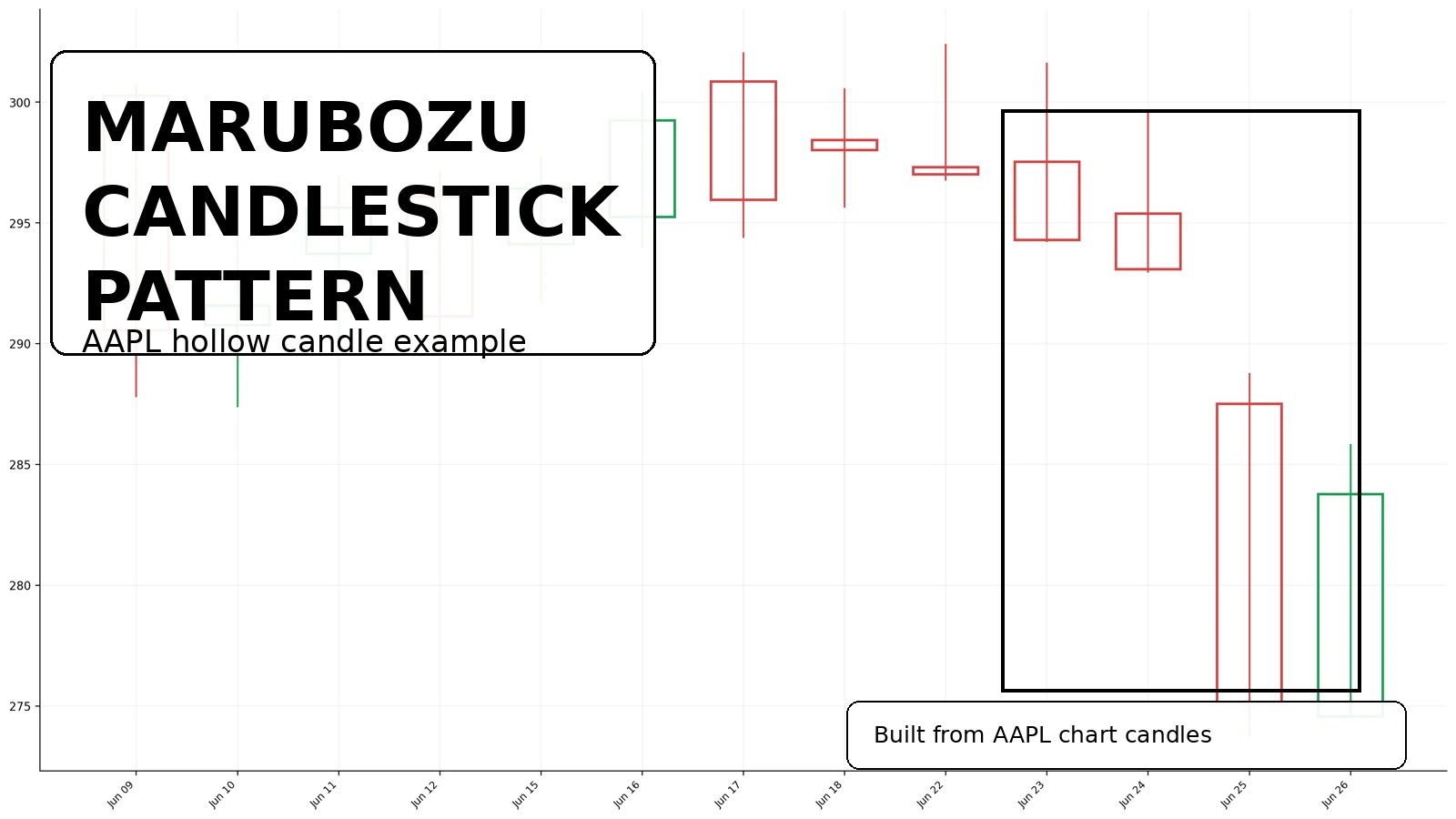
Marubozu Candlestick Pattern: What It Means and How to Trade It

What Is a Marubozu Candlestick?
A marubozu candlestick is a strong momentum candle with little or no wick. It usually shows that one side of the market controlled the full session. A bullish marubozu means buyers dominated from open to close. A bearish marubozu means sellers stayed in control from open to close. Traders use the marubozu pattern to read strength, breakout pressure, and trend direction.
The marubozu is a single candlestick pattern, so it does not need a second candle to form. Still, it should never be traded alone. Market context, trend direction, volume, and confirmation are important. A marubozu candle can appear in stocks, crypto, forex, indices, and commodities.
The Meaning of “Marubozu” in Japanese
The word marubozu comes from Japanese and is often explained as “bald” or “shaved.” In candlestick trading, this describes a candle with no visible shadow. Traders also call it a no shadow candlestick, no wick candle, or full body candle. The idea is simple. Price moved strongly in one direction without much rejection.
How to Identify a Marubozu Pattern
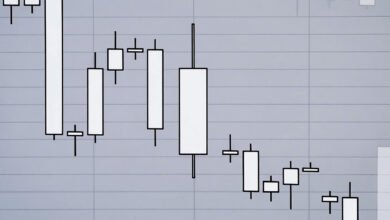
A clean marubozu candle has a long body and very small or missing shadows. In a perfect bullish marubozu, the candle opens near the low and closes near the high. In a perfect bearish marubozu, the candle opens near the high and closes near the low. The candle should stand out from nearby candles. A weak or tiny candle is not a strong marubozu signal.
The most important feature is market dominance. A bullish candle shows buyer pressure. A bearish candle shows seller pressure. The larger the candle body, the stronger the message may be. But a large candle after an exhausted move can also become a trap.
No Wicks, No Shadows: What That Tells You
A no wick candle tells traders that price faced little rejection during that period. Buyers or sellers pushed the market with confidence. This is why marubozu candles are often called momentum candles. They can show a breakout, a continuation move, or the start of a new trend. The meaning depends on where the candle appears on the chart.
A marubozu near support may show aggressive buying. A marubozu near resistance may show aggressive selling or a breakout attempt. A marubozu in the middle of a range is less useful. Location matters more than shape alone.
Types of Marubozu Candlestick
There are several types of marubozu candlestick formations. The main types are bullish marubozu, bearish marubozu, opening marubozu, and closing marubozu. Each type shows market strength in a slightly different way. The strongest version has almost no upper or lower shadow. The weaker versions have one small wick.
Bullish Marubozu: Full Buyer Control
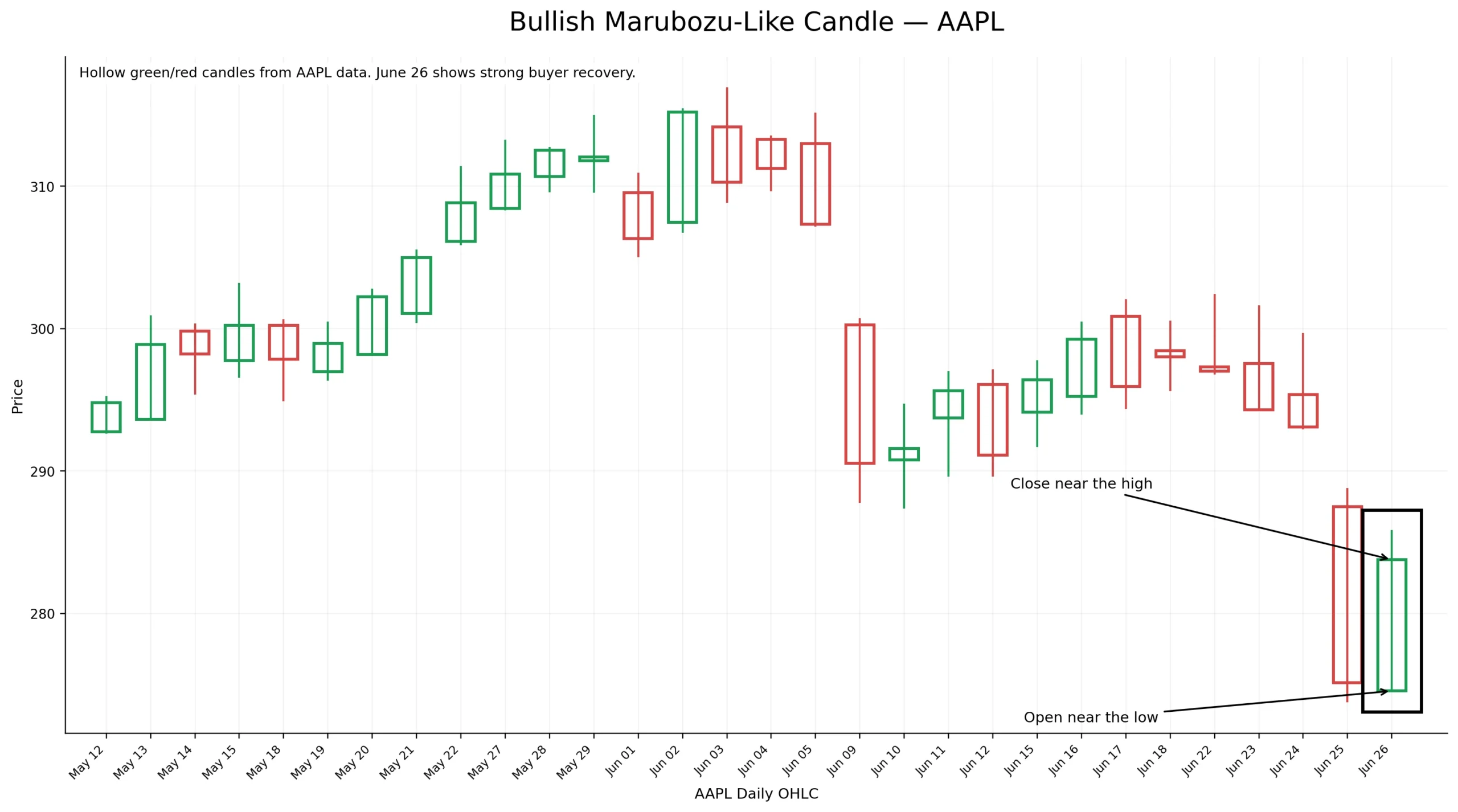
A bullish marubozu is a long green or white candle with little or no shadow. It shows that buyers controlled the session. Price opened near the low and closed near the high. This can act as a strong trend candle during an uptrend. It can also become a marubozu breakout signal when it breaks above resistance.
A bullish marubozu is stronger when volume rises. It is also stronger when it appears after consolidation. If it forms after a long rally, traders should be careful. Late buyers may enter at a bad price. Confirmation helps avoid buying into exhaustion.
Bearish Marubozu: Full Seller Control
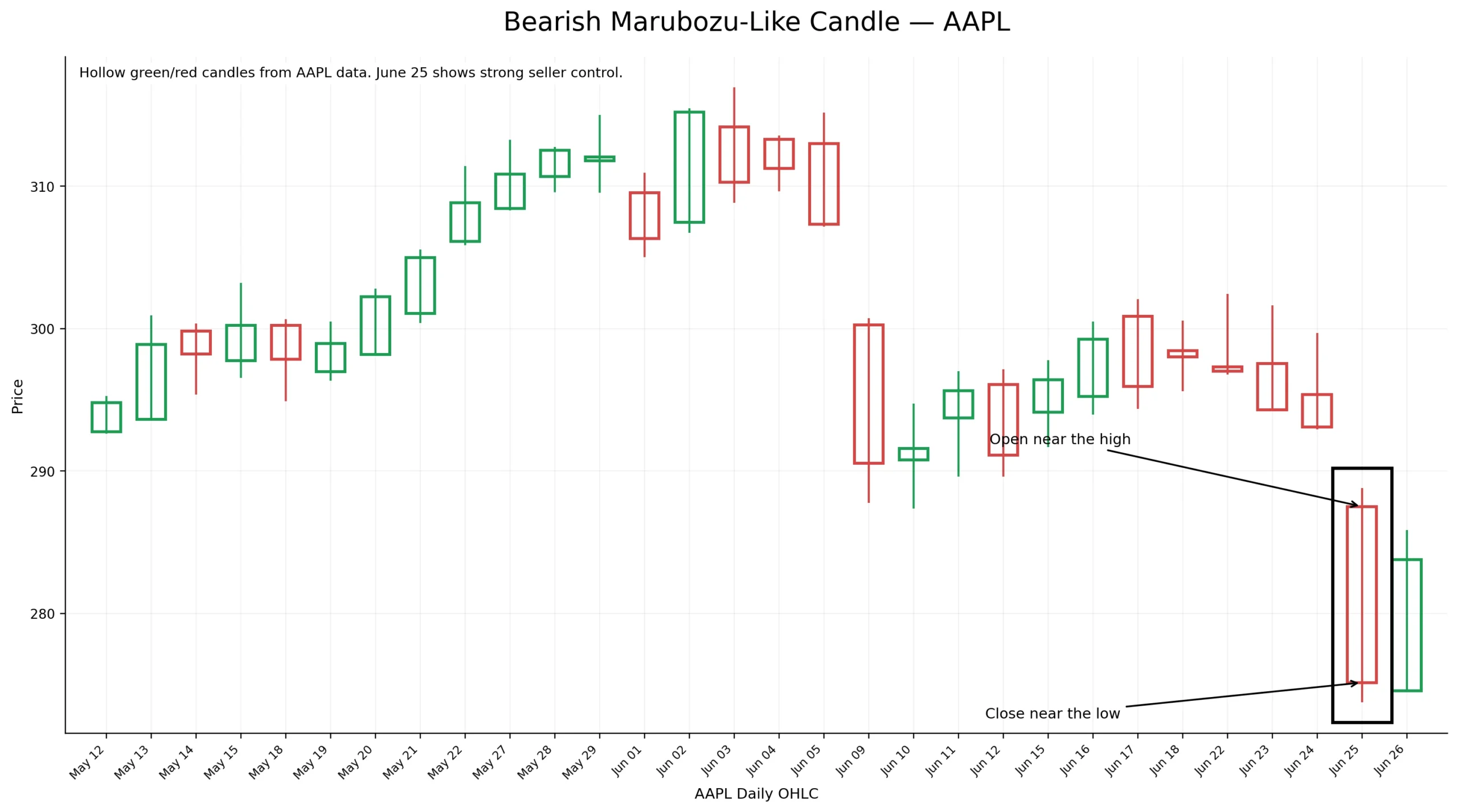
A bearish marubozu is a long red or black candle with little or no shadow. It shows that sellers controlled the session. Price opened near the high and closed near the low. This candle can confirm downside pressure in a downtrend. It can also signal a breakdown below support.
A bearish marubozu is stronger when it appears near resistance or after a failed breakout. It may also show panic selling after bad news or weak market sentiment. In crypto and forex, bearish marubozu candles can move fast. That makes stop loss planning very important.
Opening Marubozu vs Closing Marubozu
An opening marubozu has no shadow at the open side of the candle. A bullish opening marubozu opens at or near the low. A bearish opening marubozu opens at or near the high. This shows that momentum started immediately after the candle opened.
A closing marubozu has no shadow at the close side of the candle. A bullish closing marubozu closes at or near the high. A bearish closing marubozu closes at or near the low. This shows that momentum stayed strong until the candle closed.
What Does a Marubozu Signal in the Market?
A marubozu pattern signals dominance. It shows that buyers or sellers had clear control during the candle period. This is why many traders see it as a market dominance signal. A bullish marubozu points to strong demand. A bearish marubozu points to strong supply.
The signal becomes more useful when it appears at a key level. A bullish marubozu above resistance may confirm a breakout. A bearish marubozu below support may confirm a breakdown. In trending markets, the candle can support continuation trades. In overextended markets, it can warn of a possible trap.
Trend Continuation or Trend Start?
A marubozu can signal both trend continuation and trend start. In an existing uptrend, a bullish marubozu may show that buyers are still strong. In an existing downtrend, a bearish marubozu may show that sellers are still in control. After a sideways range, a marubozu may mark the start of a new move. This is why traders often watch it near breakout zones.
The candle becomes weaker when it appears far away from support or resistance. A strong candle without structure can be risky. The best setups usually have a clear level, strong volume, and a clean close. Without these, the candle may only reflect short-term emotion.
How to Trade the Marubozu Pattern
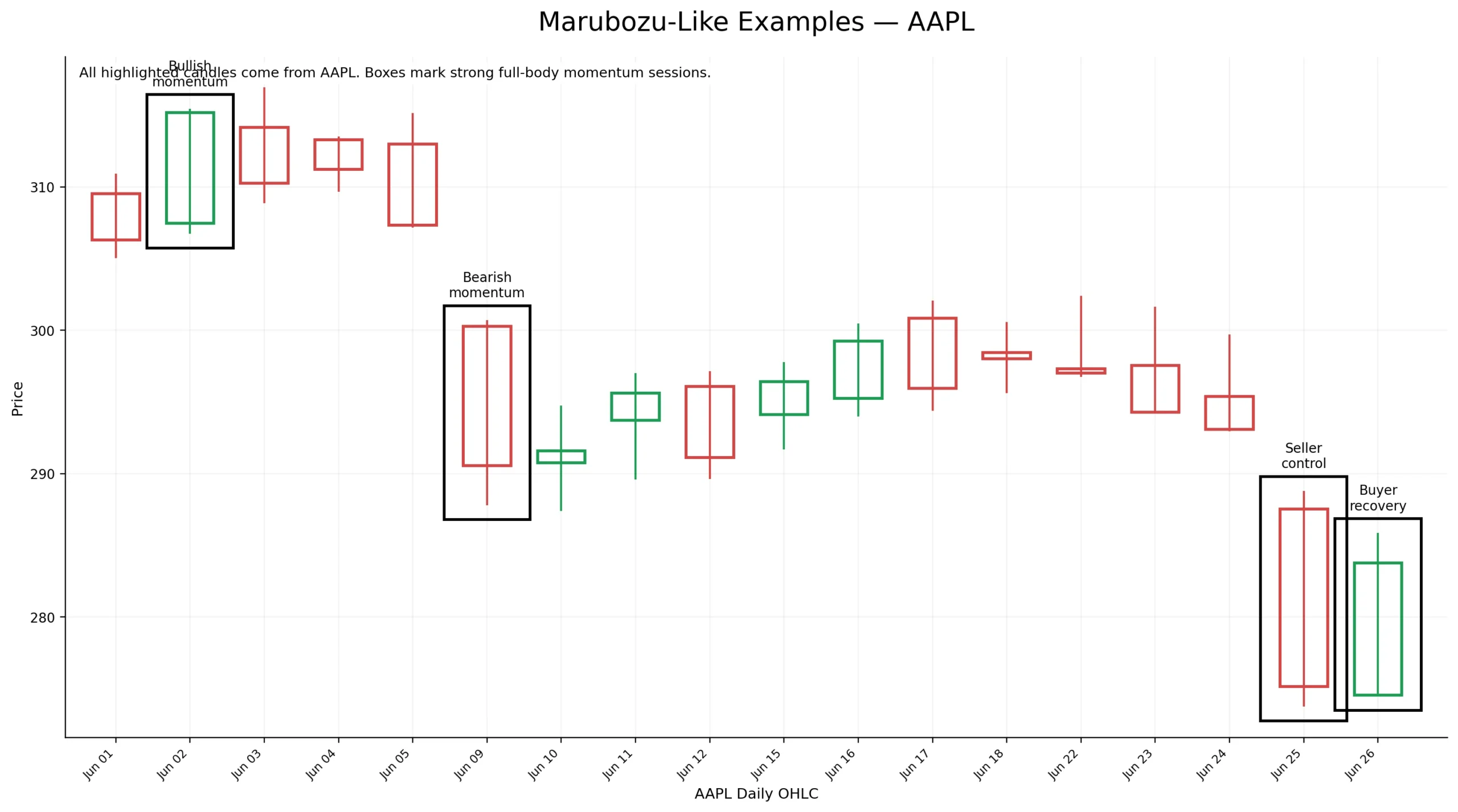
A good marubozu trading strategy starts with context. First, identify whether the market is trending or ranging. Then check whether the marubozu appears near support, resistance, or a breakout level. After that, wait for confirmation. A candle is useful only when it fits the larger chart story.
For bullish setups, traders often look for a close above resistance. For bearish setups, traders often look for a close below support. Some traders enter on the candle close. Others wait for a pullback toward the breakout level. Waiting for a pullback may reduce risk, but the market may not always return.
Entry, Stop Loss and Take Profit Levels
For a bullish marubozu, an entry can be taken after the candle closes above resistance. A more cautious entry waits for price to retest the broken level. The stop loss may sit below the marubozu candle low or below the retest area. Take profit can be placed near the next resistance. Traders can also use a fixed risk-to-reward ratio.
For a bearish marubozu, an entry can be taken after the candle closes below support. A safer entry may wait for price to retest the broken support as resistance. The stop loss may sit above the marubozu candle high. Take profit can be placed near the next support. The trade should be skipped if the risk is too large.
| Setup | Entry Idea | Stop Loss Idea | Target Idea |
|---|---|---|---|
| Bullish marubozu | Close above resistance | Below candle low | Next resistance |
| Bearish marubozu | Close below support | Above candle high | Next support |
| Pullback entry | Retest of breakout level | Beyond retest zone | Trend continuation target |
| Trend continuation | Entry with trend direction | Below/above recent swing | Risk-to-reward target |
Using Volume to Confirm the Signal
Volume confirmation makes a marubozu signal stronger. A breakout candle with rising volume suggests real participation. A breakout candle with weak volume can fail quickly. This is common in crypto, forex, and low-liquidity markets. Strong volume helps separate real momentum from fake movement.
Volume should be compared with recent candles. One candle with slightly higher volume may not be enough. Look for clear expansion. If price breaks a major level with a large marubozu and strong volume, the setup becomes more meaningful. If volume is low, patience is better.
Marubozu on Different Timeframes
The marubozu candle forex setup can appear on 5-minute, 15-minute, hourly, and daily charts. Lower timeframes create more signals but also more noise. Higher timeframes usually produce cleaner signals. A daily marubozu often carries more weight than a 5-minute marubozu. The same rule applies to stocks and indices.
The marubozu candle crypto setup can be powerful because crypto markets move fast. But crypto also creates more false breakouts and sudden wick moves. Traders should avoid oversized positions. Stop loss placement should allow for normal volatility. A strong candle does not remove risk.
Marubozu with RSI and Stochastic Confirmation
RSI and stochastic can help filter marubozu trades. RSI shows whether the market is stretched. Stochastic shows short-term momentum shifts. These tools are useful when a marubozu appears near an important level. They should support the trade idea, not replace it.
A bullish marubozu near support becomes stronger when RSI turns up from a low area. A bearish marubozu near resistance becomes stronger when RSI turns down from a high area. Stochastic crossovers can add extra timing confirmation. Still, indicators can give late signals. Price structure should remain the main focus.
Marubozu Limitations and False Breakouts
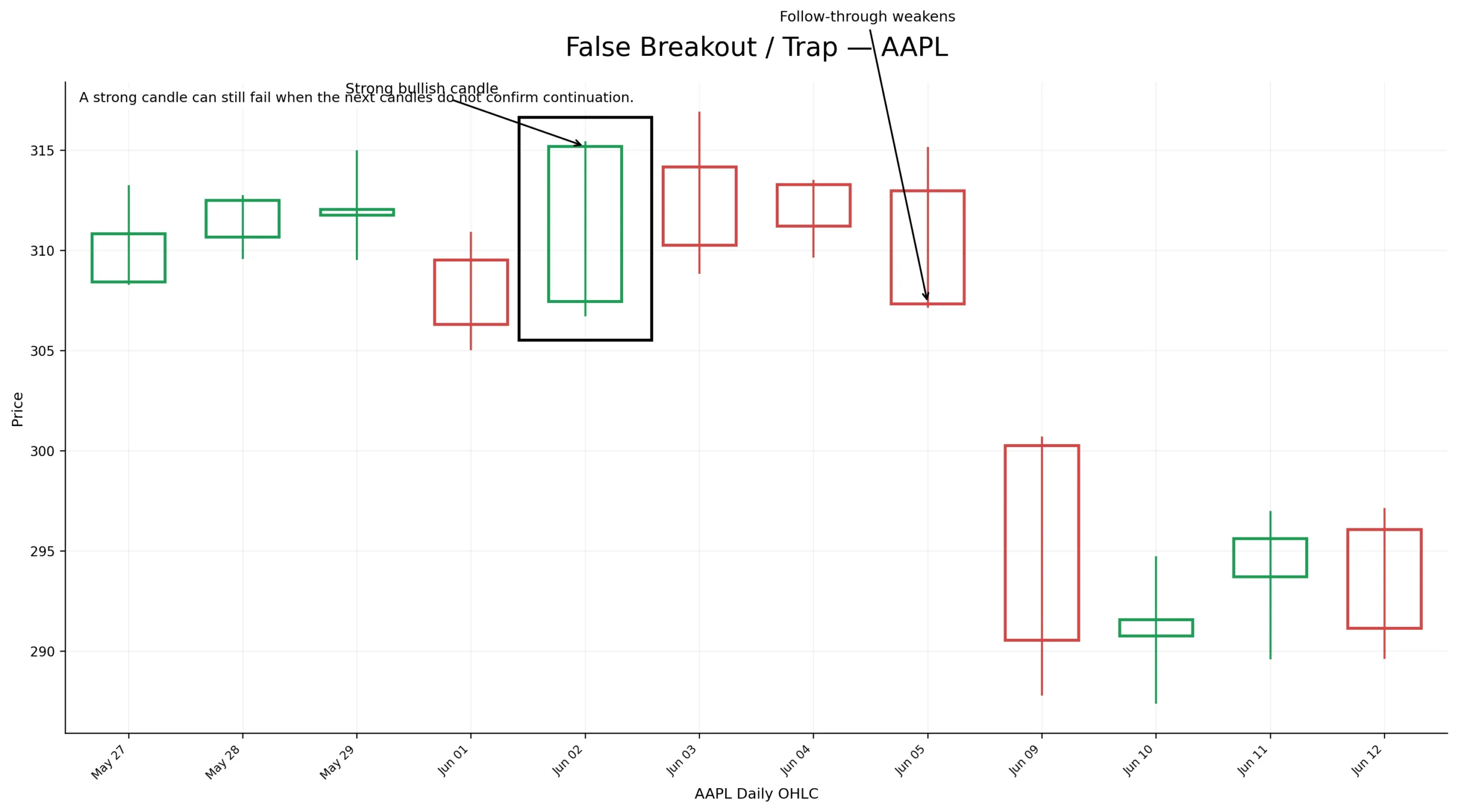
The biggest weakness of the marubozu pattern is false confidence. A large candle looks powerful, but it can also appear near the end of a move. Many traders enter late after seeing a strong candle. Then price reverses and traps them. This is why confirmation and risk management are essential.
False breakouts happen often after emotional candles. A bullish marubozu can break resistance and then fall back below it. A bearish marubozu can break support and then recover quickly. These traps are common in news-driven markets. They are also common during low-liquidity sessions.
A marubozu should not be traded blindly. It works best with structure, volume, and a clear plan. Traders should know the entry, stop loss, and target before entering. If the candle is too large, the stop loss may become too wide. In that case, skipping the trade can be the best decision.
Frequently Asked Questions
What is a marubozu candlestick?
A marubozu candlestick is a full-body candle with little or no shadow. It shows strong buyer or seller control during that candle period. A bullish marubozu shows buyer dominance. A bearish marubozu shows seller dominance.
Is marubozu bullish or bearish?
It can be both. A bullish marubozu is bullish because it closes near the high. A bearish marubozu is bearish because it closes near the low. The market context decides how strong the signal is.
Is a marubozu candle reliable?
A marubozu candle can be useful, but it is not always reliable alone. It works better with volume confirmation, support and resistance, trend direction, RSI, or stochastic. Traders should avoid entering only because a candle looks strong.
What does a no shadow candlestick mean?
A no shadow candlestick means price moved strongly in one direction with little rejection. It shows that buyers or sellers dominated the candle. This is why it is also called a market dominance signal.
Can I use marubozu in crypto trading?
Yes, a marubozu candle crypto setup can work well during strong breakouts or trend continuation moves. Crypto markets are volatile, so false breakouts are common. Use confirmation, proper stop loss, and smaller risk.
Can I use marubozu in forex trading?
Yes, a marubozu candle forex setup can be useful near session highs, session lows, support, resistance, and breakout zones. Forex traders should also consider session timing and major news events. A strong candle during low liquidity can be misleading.
What is the best timeframe for marubozu trading?
Higher timeframes usually give cleaner marubozu signals. The 1-hour, 4-hour, daily, and weekly charts are often more reliable than very low timeframes. Lower timeframes can work, but they need stricter confirmation.
What is the difference between marubozu and engulfing candle?
A marubozu is a single candlestick pattern with a full body and little or no wick. An engulfing pattern needs two candles. In an engulfing pattern, the second candle covers the body of the first candle.